
See what each deal term does to the payouts.
Merger Waterfall turns the cap table and deal documents into each shareholder's payout, shows how it moves as terms are negotiated, and produces a closing spreadsheet that proves its math.
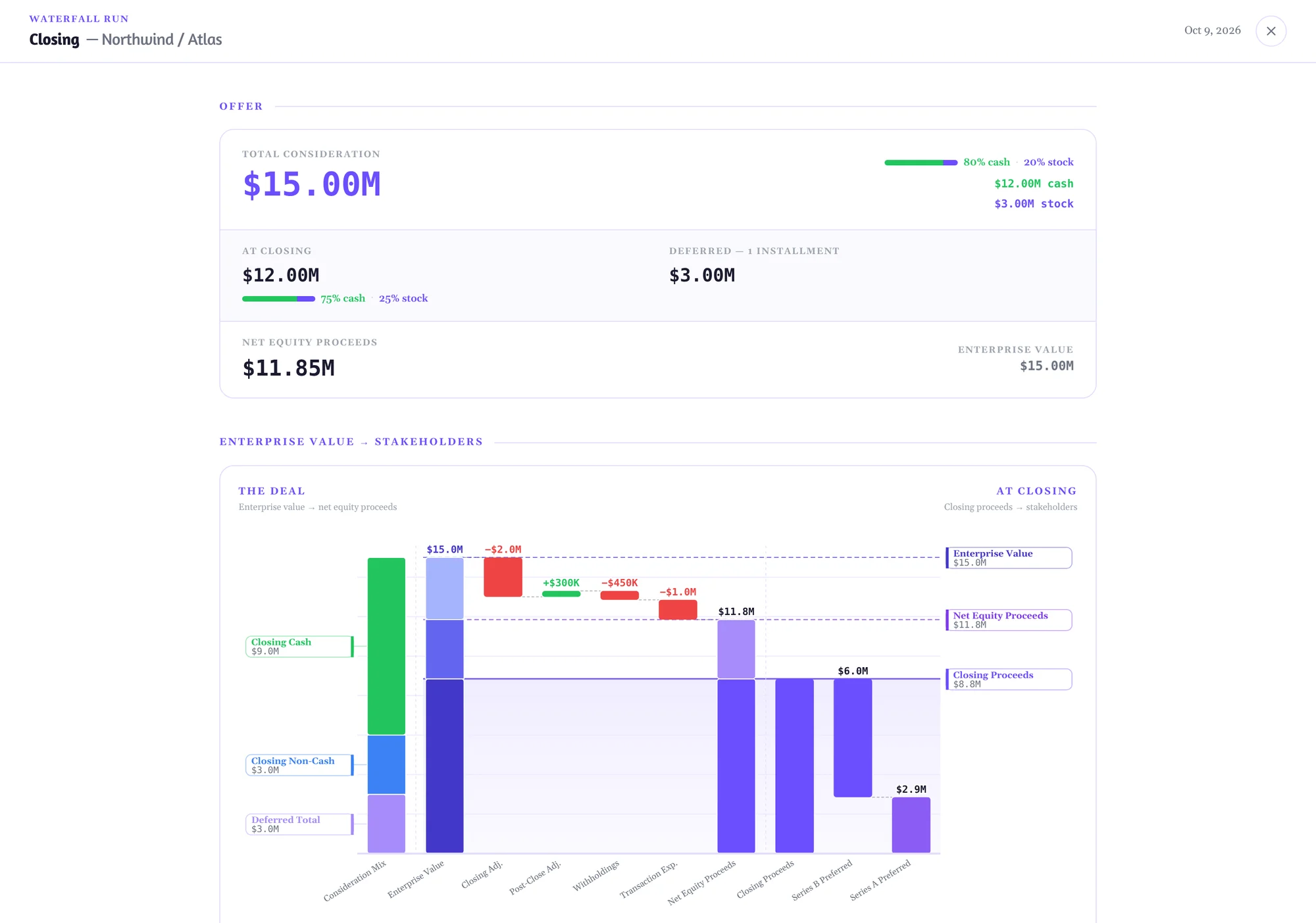
Studio showing the $15.00M Northwind Logistics / Atlas Freight Group demo deal: from headline price, through debt, holdbacks and expenses, to what each class of shareholder receives.
Who it's for
Everyone on the company's side of the table.
The people who advise on the deal, the people who paper it, and the people who are paid by it all need the same numbers, in words they understand.
Sell-side advisors
Bankers, M&A advisors, fractional CFOs
“What does this offer really pay the founders, and how do I show the board?”
Every offer turned into a payout per holder, on one picture you can present.
Company counsel
Deal and venture attorneys for the company
“What is this preference or holdback worth, before I spend a turn negotiating it?”
Each term traced to its clause and priced in dollars, for every holder.
The company
Founders, the CFO, the board, employees
“What do I actually walk away with, and when?”
Your own number, at closing and in total, and a spreadsheet you can trust.
Why Merger Waterfall
Three problems every company sale runs into.
Nobody can say what a term is worth. Every redline moves the payouts unseen. And the final spreadsheet has to be right, provably. Each has its own page.
01
“Nobody can tell me what this term means for my check.”
Deal terms, made clear
Every preference, cap and holdback turned into a dollar amount for each holder, with the clause it came from.
See how02
“Every redline moves the payouts, and nobody sees it until closing.”
Negotiations, visualized
A kept version for every turn, so each proposal's effect on every holder is visible the day it lands.
See how03
“The funds-flow spreadsheet has to be right, and I have to prove it.”
Final spreadsheets, auditably right
An exported workbook with live formulas, built-in checks and a step-by-step trace for every dollar.
See how01
Turn each term into dollars, holder by holder.
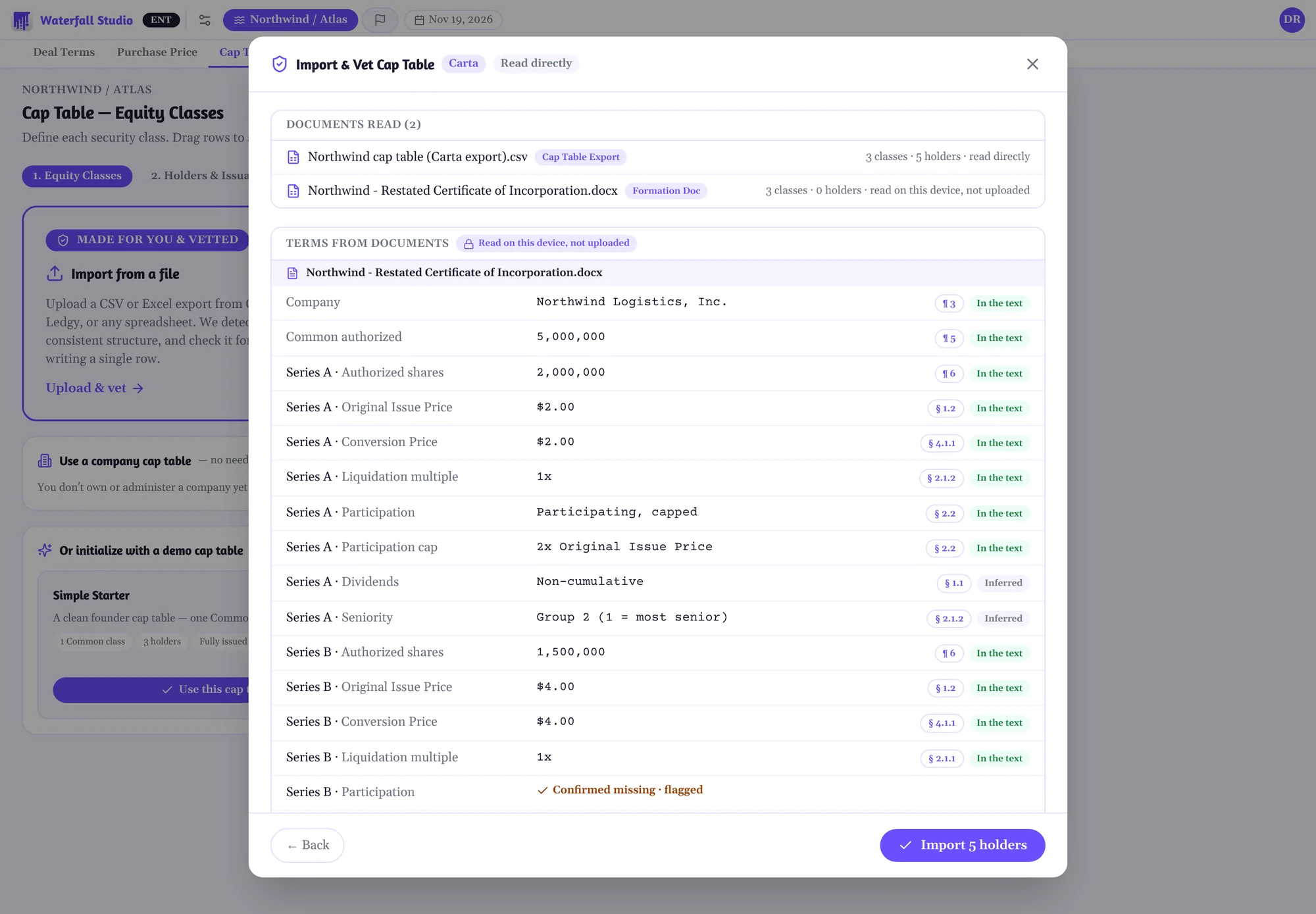
Liquidation preferences, participation, escrow and earnouts are written for lawyers. Merger Waterfall reads them from the charter and the cap table and shows, in dollars, what each one means for each shareholder.
- Every term traced to its clause
- The whole deal on one axis
- Each holder sees their own number
02
Watch the payouts move as the terms move.
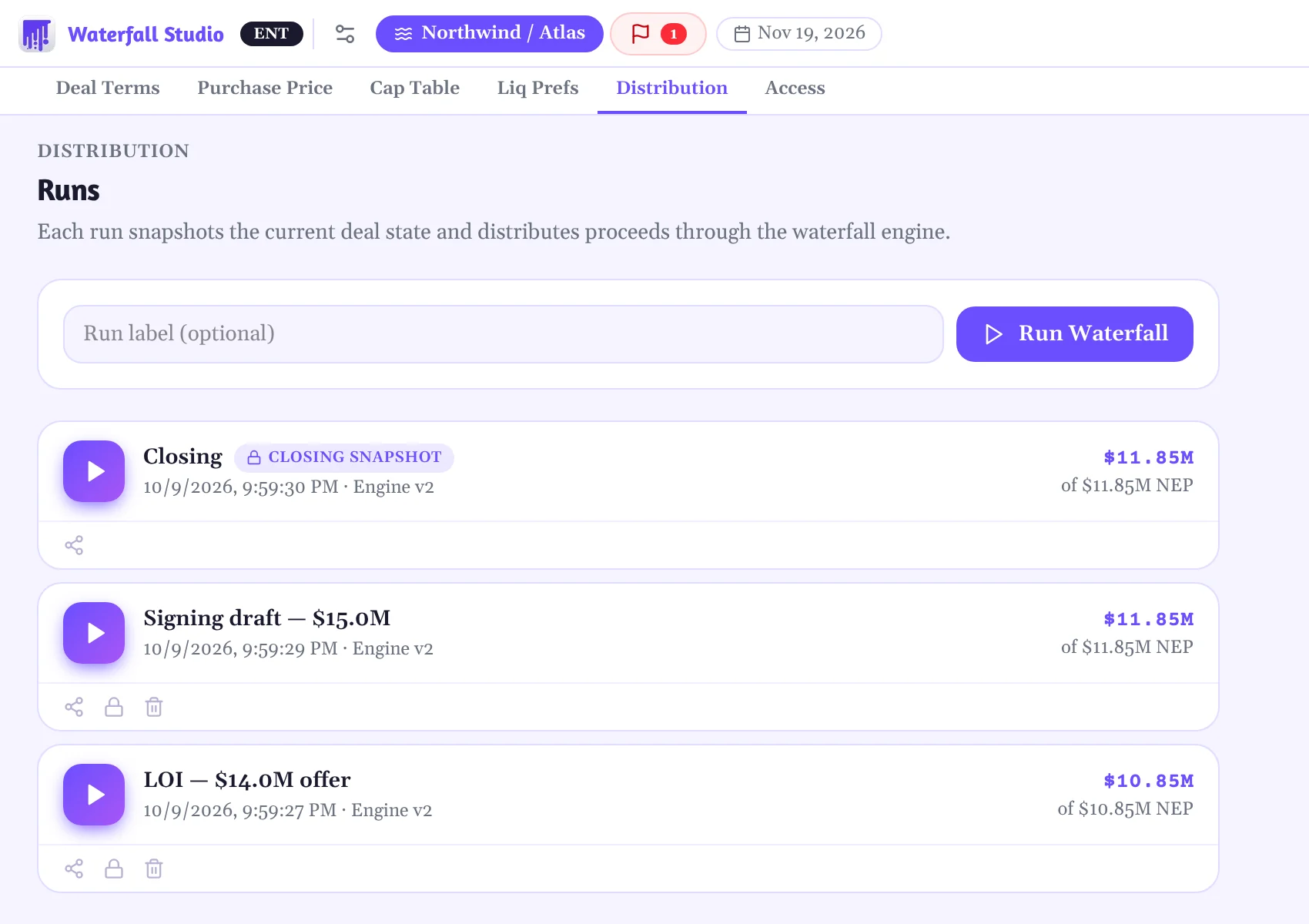
Every turn of a negotiation changes who gets paid what. Merger Waterfall keeps a version for each turn, so you can show the effect of a price change, a new preference or a bigger holdback the same day it is proposed.
- A version for every turn
- Go back to what was proposed
- Know the moment terms move on
- Ask your assistant what a change does
03
The closing spreadsheet that proves its own math.
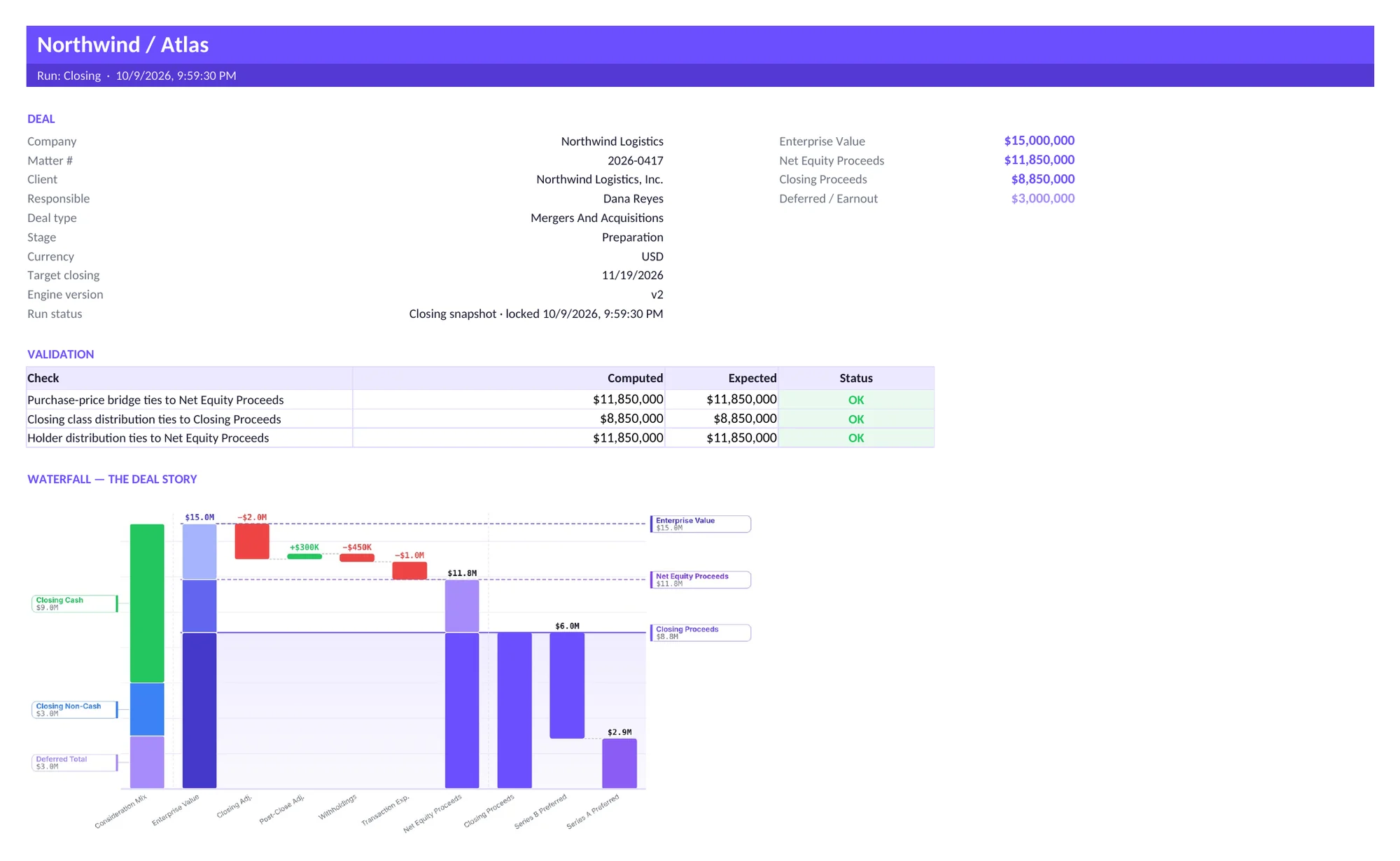
The spreadsheet that goes to the paying agent is the one document nobody can get wrong. Merger Waterfall exports it with live formulas, built-in checks and an audit trace for every dollar, from the version you locked at closing.
- Checks that re-run in Excel
- Every holder, every class, to the dollar
- A trace for every dollar
- Locked at closing
Deal scenarios
The questions clients actually ask.
Seven moments, from a financing years before a sale to the week of closing. Each is answered on the Northwind Logistics demo deal by the same engine Studio runs; every number below is computed, not illustrated.
What would a sale actually pay us?
Same cap table, same deal costs, four headline prices
Dana Reyes · Founder · CEO
The price went up $1M. What does that do for us?
LOI at $14.0M; signed at $15.0M (+7%)
Dana Reyes · Founder · CEO
The new investor wants a 1.5x preference. What does that cost us later?
Series B liquidation preference 1.0x → 1.5x
Dana Reyes · Founder · CEO
If we push back on Series A participation, how much do we get back?
Series A: participating, capped at 2.0x → non-participating
Dana Reyes · Founder · CEO
How much of our money is actually paid at closing?
$1.5M escrow and $1.5M earnout withheld; only closing proceeds distributed
Dana Reyes · Founder · CEO
The buyer raised the tax holdback. Who pays for it?
Tax withholding $450k → $500k
Dana Reyes · Founder · CEO
Deal costs came in $250k over. Does the spreadsheet still tie out?
Transaction expenses $1.00M → $1.25M
Dana Reyes · Founder · CEO
In the product
The capabilities behind it.
Consistently created from source documents
Terms come out of the charter and the cap table export, each one citing its clause.
Stakeholder-ready waterfalls
One picture for the board, and a private link for each holder.
Conversational deal terms updates
Ask what a change does to every check, in the assistant you already use.
Waterfall rollbacks and versions
Every run is kept as it was computed. The closing version is locked.
Try it on your next deal.
Bring the cap table export and the charter. Leave with a distribution spreadsheet you can hand to the board, the buyer and the auditor.